239 tonnes of CO₂. What next?

Table of contents
- 239 tonnes of CO₂. So what now ?
- Digital technology has a greater impact than we realise
- What this means for you
- Where we really stand
- An EcoVadis bronze rating
- Membership of the United Nations Global Compact
- A CSR Committee that meets every quarter
- What this actually changes, in the code and in the briefs
- What we haven’t done yet
- What next ?
- Sources
239 tonnes of CO₂. So what now ?
239 tonnes of CO₂ equivalent. This is our first carbon footprint assessment, covering the year 2024. It also marks the starting point of a journey that will take us several years. Here’s how we arrived at this figure, what we’re doing with it, and why it might matter to you.
Just a few years ago, a digital service provider talking about CSR mainly aroused suspicion. The subject seemed reserved for major clients, communications departments and annual reports.
That is no longer entirely true.
Today, a growing number of CIOs and business unit directors are asking us, right from the pre-sales stage, for our EcoVadis rating, our responsible procurement policy, or simply whether we have carried out a carbon footprint assessment. CSR has become a concrete criterion for supplier selection, particularly in tenders from large corporate clients subject to the CSRD directive.
This article is not a statement of intent. It is an attempt to explain honestly where we stand today, why we have taken this direction, and how this may affect you.
Digital technology has a greater impact than we realise
Let’s start with some figures.
In France, the digital sector accounts for 4.4% of the national carbon footprint, or 29.5 million tonnes of CO₂ equivalent per year. This is the most recent estimate published by ADEME and Arcep in January 2025, based on 2022 data.
And the trajectory raises questions. According to the forward-looking section of the ADEME-Arcep study, without mitigation measures, the digital sector’s carbon footprint in France could increase by around 45% between 2020 and 2030, and triple by 2050.
In contrast, the IPCC’s Sixth Assessment Report (AR6, 2023), produced by 195 member states, establishes that global greenhouse gas emissions must be reduced by around 43% by 2030 (compared to 2019) to remain on a trajectory compatible with limiting global warming to 1.5°C.
The gap between these two curves is not a technical detail. It is the framework within which any organisation that designs, commissions or deploys digital solutions will operate in the coming years.
Another figure is worth noting: 60% of the digital sector’s carbon footprint in France is generated during the manufacture of equipment.
In other words: it is not the electricity consumption of devices that poses the greatest environmental problems. It is the act of producing new ones.
This fundamentally changes the way we need to think about the lifespan of applications and the obsolescence of devices.
What this means for you
For a CIO or business unit director at a medium-sized or large organisation, these challenges have very tangible implications.
Firstly, the regulatory pressure is very real. The CSRD requires an increasing number of companies to publish audited non-financial data. Even though the timeline has been adjusted to 2024–2025, the requirement continues to move further up the value chain. If this applies to you, you will need your digital suppliers to be able to provide reliable data on their own environmental footprint. EcoVadis has become a de facto standard in many tenders.
Then there are the teams. Attracting talent is more directly linked to CSR than one might think. People joining BeTomorrow look at our approach. And may leave if we are not consistent. Instability in service provider teams comes at a high cost to the client: in terms of ramp-up time, technical debt and loss of context. A team that changes every eight months costs the client more than they save on the daily rate.
Finally, the product itself is affected. An application designed without regard for functional simplicity will be more burdensome to maintain, will consume resources unnecessarily, and will be harder to evolve. This is not a moral issue but an engineering one.
Where we really stand
We formalised our CSR policy in April 2026, signed by Alexandre Ribeiro, our CEO. This is not the starting point of our commitment: we have been working on these issues for several years. But it is the date on which we decided to set ourselves measurable targets and implement rigorous monitoring.
Our first carbon footprint assessment
We carried out our first carbon footprint assessment in 2026, covering the 2024 financial year.
239 tCO₂e. 8.9 tCO₂e per employee.
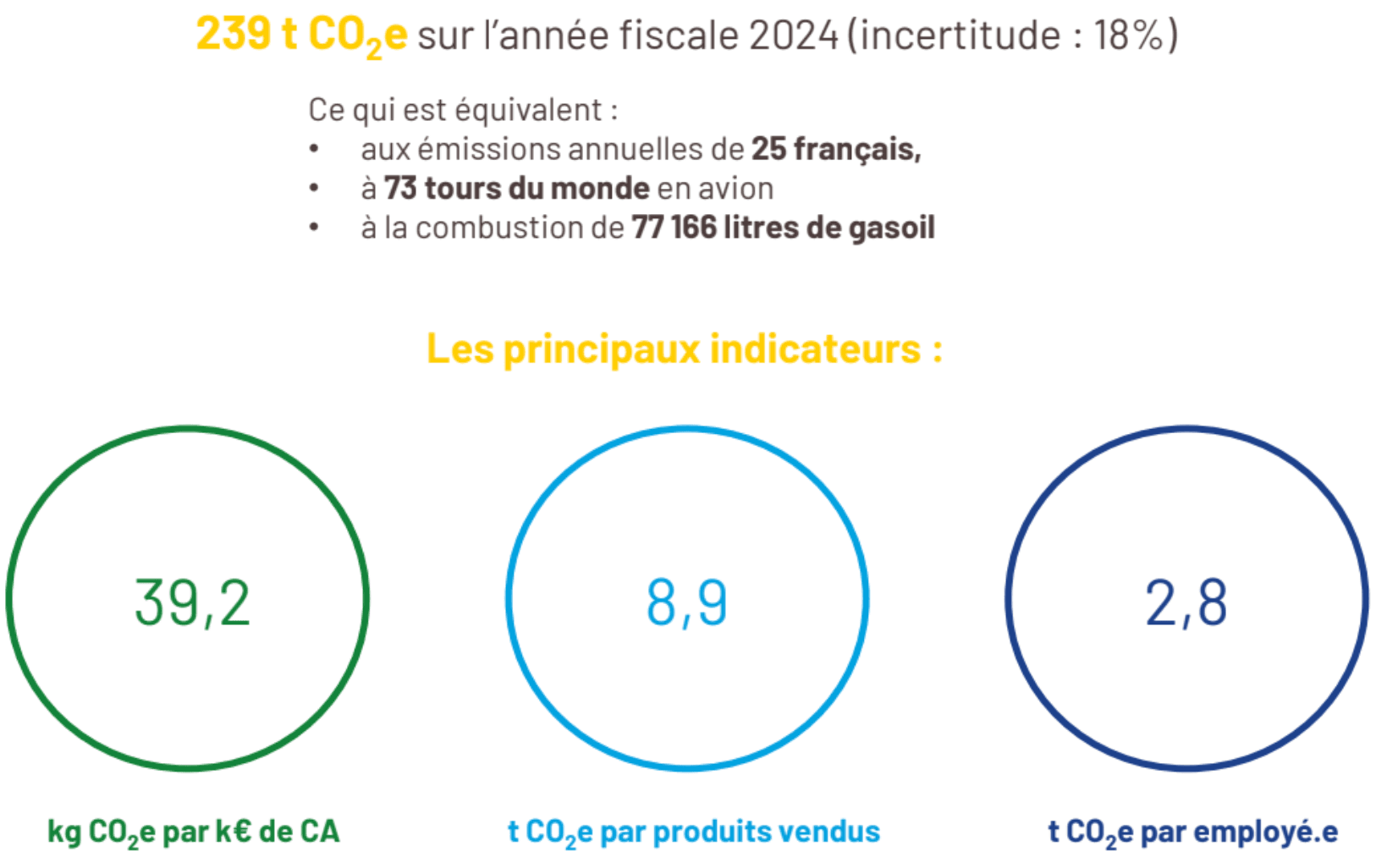
Unsurprisingly for a digital services company, the vast majority of our emissions are indirect. Three categories dominate:
41%: procurement of services (led by software, accounting for 35 tCO₂e on its own)
20%: travel
19%: procurement of goods and food
One important detail is also worth noting: 30% of the meals consumed by our teams are vegetarian. This isn’t a company policy; it’s a culture. And it’s already making a difference!
This assessment will enable us to define a reduction pathway for the most significant categories and to draw up a costed multi-year action plan. A workshop with our teams is scheduled for 22 May 2026 to develop this plan together.
An EcoVadis bronze rating
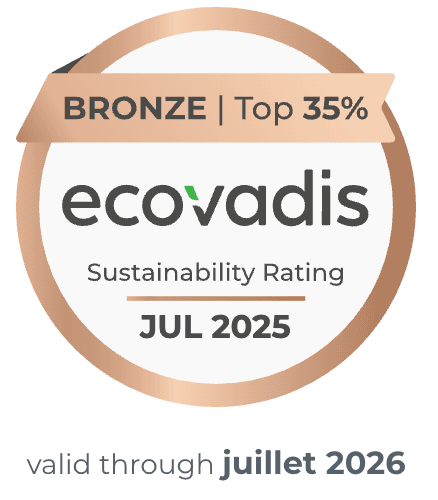
We have been awarded the bronze medal. This is not the highest level, and there are still areas where we need to improve. By saying this, we are simply being honest.
Membership of the United Nations Global Compact
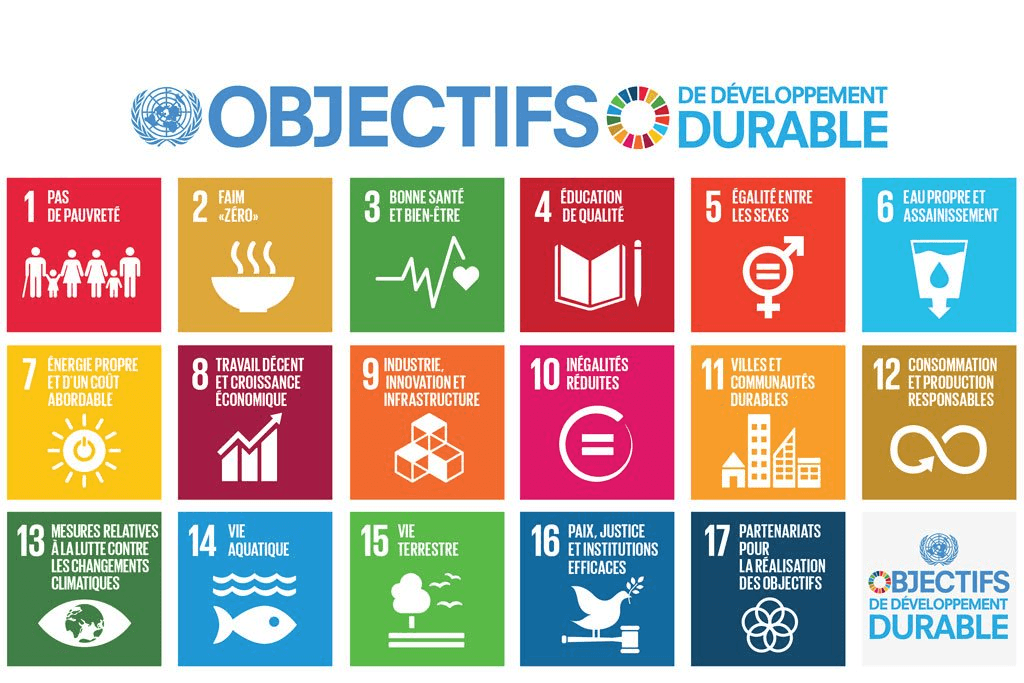
We joined in 2026, formalising our commitments to human rights, working conditions and anti-corruption practices, both in our operations and in our relationships with our partners.
A CSR Committee that meets every quarter
Since 2025, this committee has been monitoring indicators, adjusting actions and raising alerts.
What this actually changes, in the code and in the briefs
CSR is only useful if it brings about real change in our day-to-day work. For us, this involves several practices.
Eco-design is one of the skills we know how to apply. The General Framework for the Eco-design of Digital Services (RGESN) sets out a framework that we use as a basis.
But let’s be honest: we don’t claim to apply eco-design to all our projects. That would be untrue. We have the skills to do so; we apply them on a project-by-project basis depending on the scope and level of ambition agreed with our clients. Our goal for 2027: for it to become the default standard, not the exception.
Functional simplicity is part of our discussions right from the scoping phase. It’s not always straightforward; there’s often a tension between the scope of the project and the ability to maintain a product sustainably. We try to identify this tension early on, rather than discovering it during the project run.
We believe in the value of stable, committed teams, both for our staff and for our clients who benefit from them. Our project teams are in-house. We only use partners in a targeted and limited way. A team that knows the product, the context and past decisions means less waste, fewer reworks and less wasted energy.
What we haven’t done yet
We don’t intend to stop there.
We still need to strengthen our ethical framework, particularly by formalising certain internal policies and procedures. Several initiatives are currently underway to further structure our practices and ensure more consistent monitoring over time.
We also need to take a significant step forward in responsible procurement. A dedicated training course for our procurement manager is planned for summer 2026, along with the gradual implementation of a process to assess and rate our suppliers against CSR criteria.
Our remuneration framework is not yet finalised, although work is ongoing.
Our carbon action plan, which will be developed jointly with our teams during the workshop on 22 May 2026, will be published later this year.
These projects are ongoing, but we have chosen to highlight them nonetheless.
What next ?
If these issues are on your mind – whether in the context of a tender response, CSRD reporting, or simply because you want to better understand the impact of your digital projects – we are available to discuss them.
Not to sell you a certification. But to share what we are learning, and to understand what you need.
Sources
ADEME, Assessment of the environmental impact of digital technology in France, updated January 2025 (2022 data) ecoresponsable.numerique.gouv.fr
Ministry for Ecological Transition, ADEME-ARCEP forward-looking assessment for 2030 and 2050, 6 March 2023 ecologie.gouv.fr
IPCC, Sixth Assessment Report — Synthesis Report (AR6 SYR), 2023 ipcc.ch