Communication & branding to support the Île-de-France Region
EXPERTISES
As part of its transformation, the Île-de-France Region has launched the AI Program, an ambitious initiative to experiment with artificial intelligence in public service. Thought of as a strategic lever, it's based on a pragmatic, human-centric approach, with the aim of improving public policies and making life easier for Ile-de-France residents.
The program is organized around two components: Producing with concrete projects designed to enhance the efficiency of public services ; Transforming by training staff to become players in the transition.
Key areas: Identification of business needs by the departments concerned ; supervised one-year trial phase, with dedicated resources ; gradual empowerment of teams, through workshops, training and discussion sessions
The AI Program is now a strategic priority, mobilizing all employees. This rare public-sector initiative combines inspiration, training and support.
identity
for this long-term program
agents
were able to benefit from this programme
month
to develop the project

CHALLENGES
Design
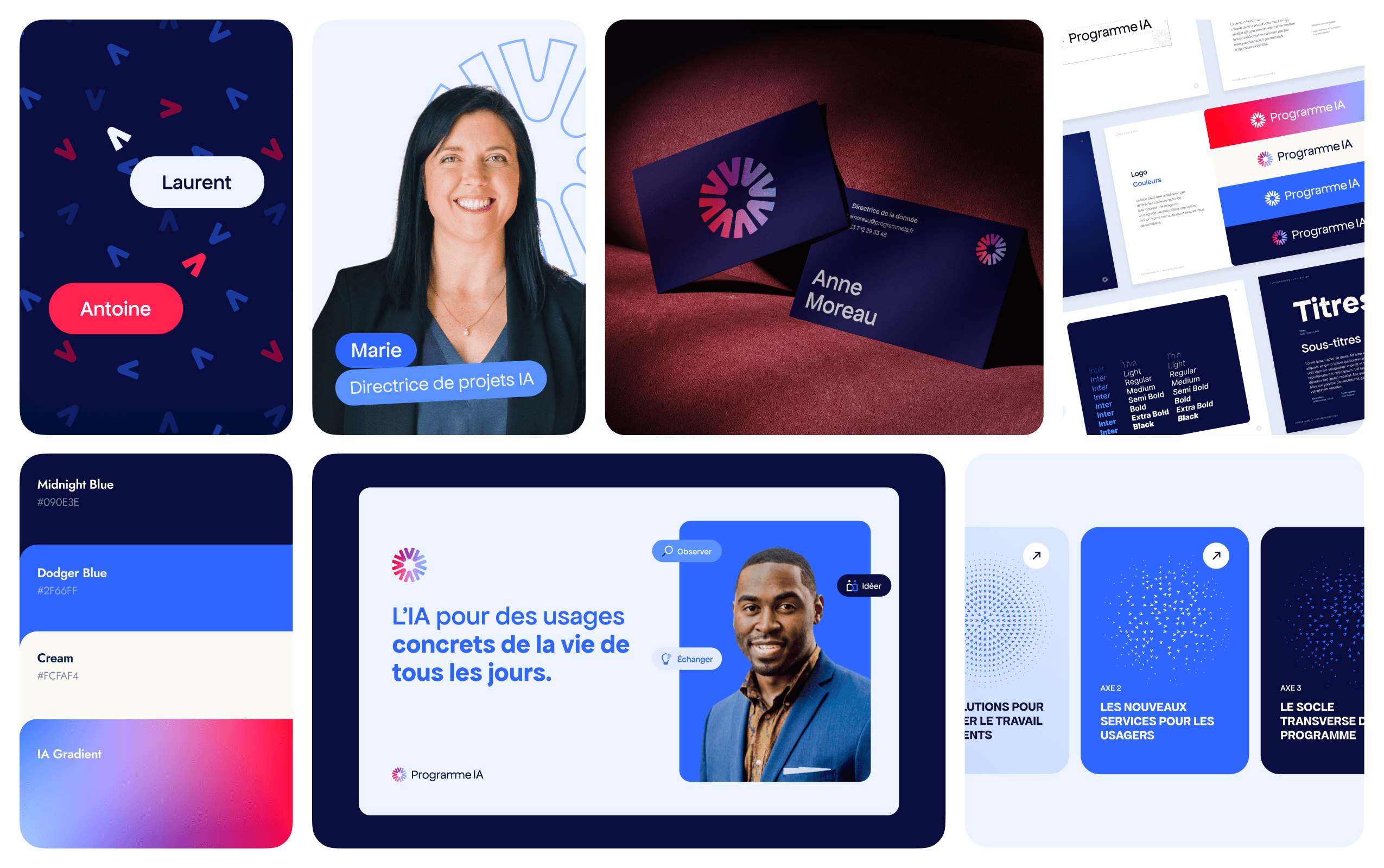
Reconciling a visual break with an institutional framework thanks to close collaboration between product and brand design. The design of the IA Program is the result of a collaborative effort between product and brand designers to assert a singular visual identity, at odds with traditional AI codes. Together, they designed a contemporary, engaging and warm interface that promotes innovation while respecting the sobriety and credibility expected in an institutional context.
Using generative AI to create a human, coherent and branded iconography: image generative AI tools were explored to design an iconography aligned with the program's graphic identity. The aim was to produce images that were tailor-made, evocative and accessible, in line with the color palette, the human values conveyed by the project and the requirements of institutional communication.
Designing a filter grid that is both clear and educational: the challenge was to structure a multi-entry filter system capable of efficiently sorting a large volume of content, while at the same time making the scope and diversity of the program's actions legible at a glance. The UX challenge: to articulate visual hierarchy and interaction logic to combine clarity of use and immediate understanding of the scope of action.
Marketing
The marketing support provided enabled us to define a brand positioning and prepare an internal communications plan to support the AI change.
The plan helps to increase internal visibility and understanding of the program's purpose, which is to enhance the value of people.
One of the elements of the plan was a dedicated space on the intranet to centralize information and an internal training plan created by the HR department.
CONCLUSION — AI THAT IS ROOTED IN REALITY
This project illustrates a reality that is often underestimated: artificial intelligence does not transform organisations on its own; it is the way it is used that does so.
With the AI Programme, the challenge was not merely to deploy technologies, but to create the conditions for their widespread adoption. This involves both concrete projects and efforts to educate, train and mobilise teams.
The role of branding and communication was to make this transformation clear, accessible and engaging, within a demanding institutional context. By asserting a more human identity that is closer to how the technology is actually used, the programme was able to move beyond abstract representations of AI and become part of staff members’ daily lives.
Beyond the tools themselves, this project demonstrates that the success of a transformation rests on a balance between strategic vision, human support and the ability to make change tangible.

LÉA FOURNIER
Brand Designer
« Designing the identity for the AI Programme also meant tackling a representational challenge: AI is now at the heart of many visual narratives, often dominated by cold, technical or futuristic codes. We sought to understand these emerging codes in order to challenge them more effectively, and assert a position that is different, warmer, more human.»
Our Client
The Île-de-France region is a public-sector player committed to the digital transformation of services and innovation in the service of its citizens. A region of excellence in research, it has made artificial intelligence a strategic lever for modernizing public action.
With the AI Program, the Region is asserting its determination to remain at the forefront of technological transitions, by placing human beings at the heart of uses and supporting agents in the appropriation of these tools.

ANTOINE CARETTE
Data Manager
“Île-de-France Region is Europe's leading economic region and is positioned as Europe's leading AI hub, with a dynamic ecosystem. The Paris Region is using digital technology and Artificial Intelligence as a lever to simplify the lives of citizens, make administrative procedures easier and, more broadly, transform relations with users and businesses. The Region's AI programme is part of this strategy and aims to put AI to work for everyday needs, with concrete applications in transport, administration, education and training.”
FREQUENTLY ASKED QUESTIONS – AI, BEYOND THE HYPE
Why is it more complex to implement AI in the public sector than in the private sector ?
Because the issues at stake are not merely technical or economic. In the public sector, every transformation raises questions of transparency, trust and accountability, with higher standards than in the private sector.
The introduction of AI must navigate a strict regulatory framework, a wide variety of roles and situations, as well as constant attention to the impact on users. The complexity is therefore as much organisational as it is operational, and cannot be addressed solely from a technological perspective.
Why is adoption the real challenge for an AI programme ?
Deploying a technology does not guarantee that it will be used. In an institutional context, success depends above all on staff’s ability to understand the tools, take ownership of them and integrate them into their daily practices.
This requires in-depth support that goes beyond simply providing solutions. Without this adoption, even the most effective systems remain theoretical. AI is only valuable when it is put to practical use.
What role can branding play in such an institutional project ?
In this context, branding does not seek to entice but to clarify. When dealing with a subject such as artificial intelligence, which is often perceived as abstract or complex, it helps to structure the narrative and make initiatives more accessible.
It also plays a vital role in fostering ownership, by creating a framework that is understandable and accessible to staff. It is not merely about communication, but a tool to facilitate understanding and engagement with the programme.
What makes a transformation credible in the public sector ?
A transformation only becomes credible when it translates into concrete, visible and gradual actions. It cannot be based solely on a vision or an intention.
This means, in particular, relying on:
tangible projects that deliver immediate benefits
a genuine improvement in teams’ skills
long-term support
Credibility is built over time, through consistency between stated ambitions and observed results.
Why combine experimentation with gradual roll-out ?
Actual usage patterns cannot be fully anticipated in advance. Experimentation allows ideas to be tested against reality, enabling the identification of necessary adjustments and the refinement of systems prior to wider roll-out.
This approach reduces risks and helps to embed solutions within practical working practices. It facilitates a more controlled transformation, capable of evolving in response to feedback from the field.
In what way does this programme go beyond a mere technological project ?
The AI Programme is not limited to the introduction of tools. It forms part of a broader transformation that affects the organisation, skills and internal culture alike.
It is not simply a matter of providing the necessary tools, but of evolving practices and ways of working. This systemic approach is essential to ensuring the transformation is sustainable.
What makes a programme like this a success ?
Success is not measured solely by the number of projects launched, but by their ability to deliver tangible value. This requires genuine buy-in from staff, improved working practices and a noticeable impact on services.
Ultimately, success depends on striking a balance between strategic vision, quality of execution and ownership by the teams