Agritech and livestock farming: what works in the field?
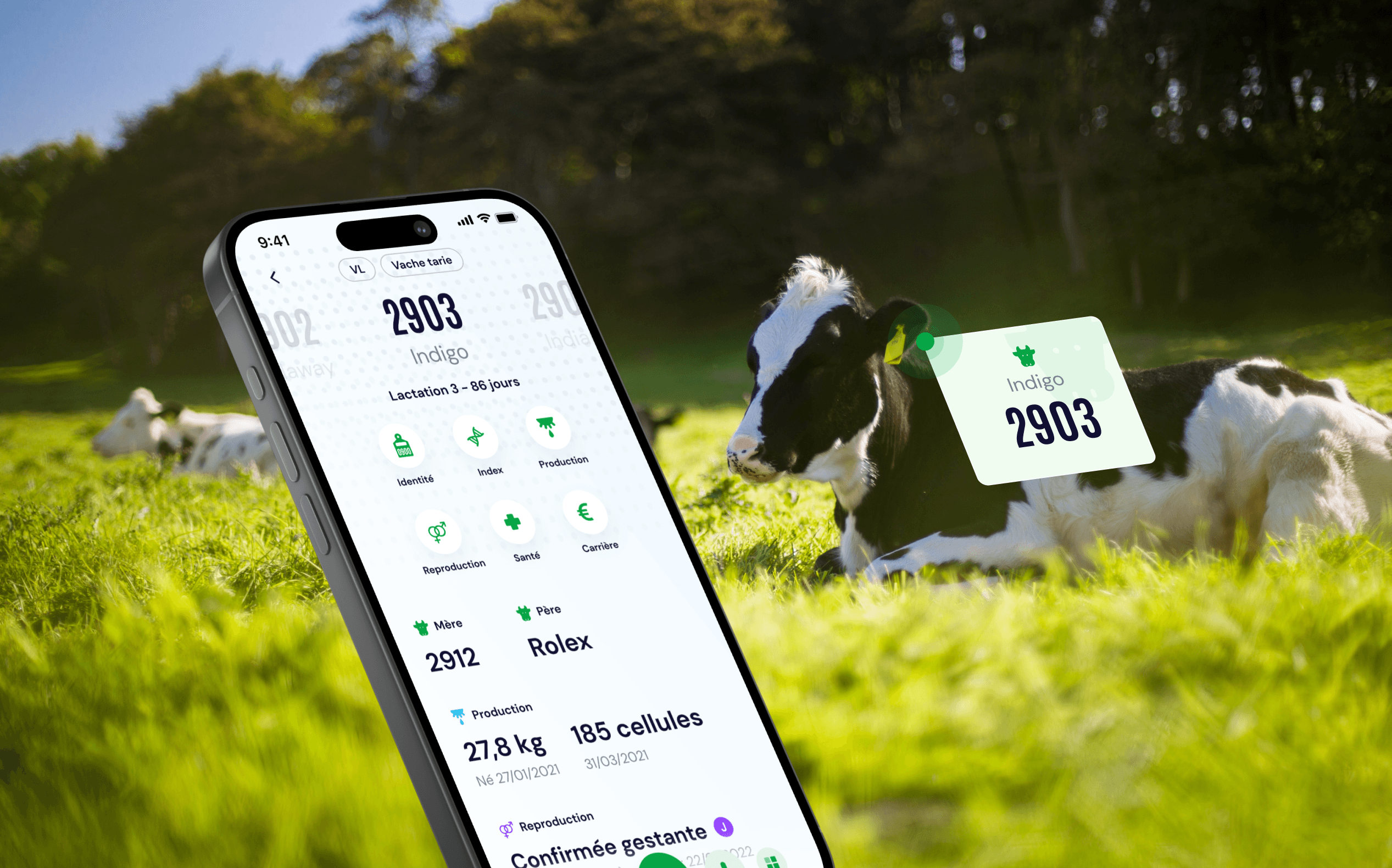
Table of contents
A farming app can look convincing in a demo and become unusable at the back of a livestock building. The connection drops. The phone is old. The farmer needs to find an animal record within seconds, sometimes with both hands busy. Meanwhile, reproduction, animal health and production data remain scattered across several tools.
This is where the real value of agritech in livestock farming is decided. A digital product has to work under farming conditions, protect data quality and reduce paperwork without adding another burden. Our work with cattle, sheep and goat farming organisations has taught us to start with these uses, then choose the technology. The next SPACE trade show, held from 15 to 17 September 2026, will put that field requirement to the test once again.
What does agritech mean in livestock farming?
Agritech in livestock farming covers technologies designed to help farmers and the organisations that support them monitor animals, manage herds and make decisions based on reliable data. It includes mobile apps, livestock software, sensors, connected devices and selected uses of artificial intelligence.
That definition is broad. Field needs are far more specific: identify an animal, record a birth, check a health history, prepare an intervention or follow a vaccination protocol. The worth of herd management software starts with the time it gives back to farmers and the reliability of the information available when they need it.
Adding more sensors is not enough to create connected livestock farming. Data must move between tools and lead to an understandable next step. Digital livestock farming starts with a work task, not with a catalogue of technologies.
Adoption is already well under way. A 2023 survey of 2,014 French ruminant farmers found that 53% of the dairy cattle farms surveyed use at least one type of animal-mounted sensor. Respondents also reported clear difficulties: poor interoperability between technologies for 70%, data privacy concerns for 66% and network access problems for 62%.
These figures shift the question. Digital tools already have a place in livestock farming. The task now is to design products that preserve useful working habits and avoid creating new dependencies.
An agritech app should be tested without a network first.
In an office, offline mode may look like one feature among many. On a farm, it can decide whether an app becomes part of daily work or gets abandoned. An offline app for farmers must let them view and enter information without a connection, then synchronise changes when the network returns. It must also handle conflicting edits without losing data.
Hardware brings other constraints. The app has to remain readable on an older smartphone, respond quickly and communicate with scales or sensors over Bluetooth. Voice input and photo-based ear tag reading can shorten some tasks, provided that they work with farm noise, dust and real working gestures.
We applied these principles when designing ExploreApp for Groupe Seenergi. Distributed as a white-label app by Pilot’Élevage, it covers identification, reproduction, health, dairy data and beef data for cattle, sheep and goat farms. Offline access and support for a wide range of phones address a well-documented rural constraint. The Pilot’Élevage case study sets out the choices made for synchronisation, security and interface design.
The delivery method matters as much as the code. Rollout began with 20 test herds, then moved forward in stages using farmer feedback. Field testing limits a common risk: building a function that works technically but proves too slow or too complex at the moment of use.
How can data be connected without locking farmers in?
A farm produces information across many systems: identification, reproduction, weighing, milk recording, health events and animal movements. Bringing it together in one app makes work easier, but it also gives the organisation behind the service a serious responsibility.
Several rules should be written before development starts. Who can read each record? Who can correct it? How long is it kept? How can the farmer retrieve it? Exchanges with existing systems need to be part of the architecture from the start. Security cannot be added at the end, especially when several roles have access to the same herd.
The French Ministry of Agriculture has identified the risk of farmers becoming dependent on digital tools whose providers follow different interests. It also notes that control over agricultural data still relies heavily on supplier contracts. For an IT department, digital director or livestock advisory body, interoperability and reversibility directly affect trust and product life.
Pilot’Élevage synchronises data for more than 2.2 million animals. The mobile app has 10,000 active users, is used by 80% of Groupe Seenergi partner farms and records 95% user satisfaction in a representative survey. These figures do not prove that one isolated feature is good. They show that a coherent product, tested in the field and maintained over time, can earn a place in daily work.
The goat farming case leads to the same finding. UBIQ, designed for Seenovia, lets farmers enter and retrieve data on animals, weighing, reproduction, health events and groups from a smartphone. The scope changes, but the rule remains: information should be available where the decision is made.
What role should AI play in animal health?
Search interest in AI for agriculture is higher than for very specialised livestock queries. That signal does not justify adding a conversational assistant to every piece of farming software. In animal health, an inaccurate answer or one missing key context can cause more harm than a poor content recommendation.
A useful assistant needs a defined scope, should identify the data behind its answer and must recognise requests beyond its role. Access rights, information freshness and answer traceability need close control. The farmer keeps the decision, and the veterinarian remains essential whenever diagnosis or prescription is involved.
Herdy, the connected assistant within Pilot’Élevage, provides natural-language access to reproduction, animal health, milk production, genetics and growth information. Its practical benefit comes from shortening the path between a question and herd data. It received an Innov’SPACE award in 2025.
In 2026, Pilot’Élevage Vaccination received a two-star Innov’SPACE award. The module helps farmers follow protocols and due dates. The official Innov’SPACE 2026 awards page lists digital technology, AI and animal health among the main themes of the event. The award concerns a defined and verifiable use, rather than a broad claim about AI.
What should be checked before launching a digital product for livestock farming?
Four questions can test a project before development spending begins.
Does the problem occur often enough to justify a new tool? A rare difficulty may not lead to lasting use.
Will the app work without a network and on the equipment farmers actually own? Testing should take place on a farm, not only in a lab.
Can data move between systems, remain under control and be retrieved? Each party’s responsibilities should be explicit.
Can the outcome be measured after launch? Data entry time, usage rate, data quality and user satisfaction are stronger signals than the number of features delivered.
These questions also support hard choices. Simplifying an existing step may be more useful than adding AI, another sensor or a new dashboard. An agritech product earns its legitimacy through repeated daily use.
SPACE offers a useful place to compare claims with farming practice. Farmers, advisory bodies, animal health companies and software publishers can all ask the same question: does the product hold up under real livestock farming conditions?
We will be there with a conviction shaped by Pilot’Élevage and UBIQ. A good agricultural digital product works offline, respects data rights, communicates with existing systems and saves time without pulling farmers away from their animals. Talk to us about your agritech product before or during SPACE 2026.
QUESTIONS ABOUT AGRITECH IN LIVESTOCK FARMING.
What does agritech mean in livestock farming?
Agritech in livestock farming includes mobile apps, herd management software, sensors and selected uses of artificial intelligence. These tools help farmers follow animal identification, reproduction, production and health. Their usefulness depends on whether they work under real farming conditions and exchange data with the systems already in use.
Why should a herd management app work offline?
Mobile coverage remains unreliable in many livestock buildings and pastures. Offline access lets a farmer view an animal record and enter an event without a network. Changes are synchronised when connectivity returns. The app must also handle conflicting entries so that no data is lost when several devices are used for the same herd.
How can AI support animal health monitoring?
AI can shorten access to herd data, flag certain changes and help retrieve an animal’s health history. It should work within a defined scope, with current data and traceable answers. It does not replace the farmer’s judgement or the veterinarian when diagnosis or prescription is required.
What should you check before choosing livestock software?
Livestock software should be tested on a farm, without a network and on the phones users actually own. Check whether it can exchange data with existing systems, how access rights are managed and how information can be retrieved. Data entry time, usage rate and user satisfaction should also be measurable after launch.
What is the difference between agritech and precision livestock farming?
Agritech covers the technologies applied across agriculture and livestock farming. Precision livestock farming refers more specifically to the use of sensors and data to monitor animals, detect changes and adapt interventions. It is one part of agritech, alongside work apps, connected devices and AI-based assistants.