Turning field data into a decision-making tool
EXPERTISES
Unwanted inflow poses a major challenge for sewerage network operators. Caused in particular by seepage, non-compliant connections or rainwater inflow, it disrupts the normal operation of the networks by increasing the volumes transported and treated. The result is reduced hydraulic performance, higher operating costs and greater difficulty in identifying anomalies in the field.
To support SUEZ in addressing this issue, BeTomorrow helped to scale up SUEZ ECP, a business-oriented digital solution designed to reduce excess clear water. The project was based on an existing technical infrastructure combining a Python backend, business calculations, large volumes of GIS data and hydraulic data. The aim was to make this processing chain more robust, more reliable and easier for the teams to use.
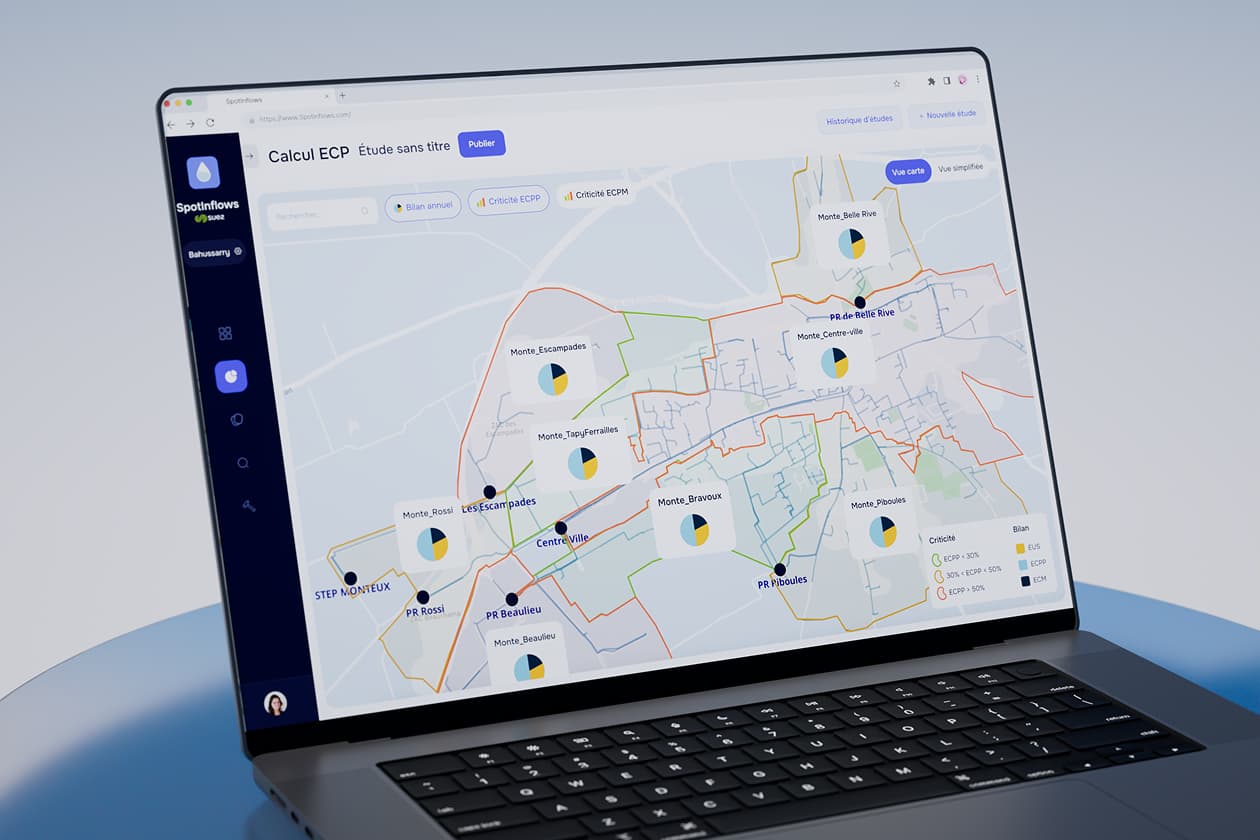
BeTomorrow worked on several complementary components: optimising the Python calculation module, processing field data, utilising GIS data, algorithmically reconstructing the network, and developing a mapping interface. The solution enables users to import data, visualise network layers, view the results in the form of indicators and maps, and then export the information required for analysis.
One of the key technical challenges was to automatically reconstruct the upstream/downstream relationships between collectors in order to reconstruct the topology of the sewerage network using data that was sometimes incomplete or imperfect. This approach helps teams to better identify areas of intrusion, visualise useful signals and prioritise interventions where they will have the greatest impact.
complex, structured GIS
A solution designed to analyse large volumes of diverse network data: collectors, manholes, basins, measurement points, flow rates and rainfall data.
a more reliable and optimised ECP engine
The ECP calculation module has been refined and optimised to improve its reliability, performance and maintainability.
better prioritised areas of intervention
A mapping and sector-specific analysis to identify the areas most affected, target investigations and guide maintenance investment.
CHALLENGES
Tech
The main technical challenge centred on the industrialisation of an existing system combining ECP calculations, a Python backend, hydraulic data and large volumes of GIS data. The aim was to ensure the reliability of the processing, optimise performance and make the calculations more robust for regular business use. The project also required algorithmic work on reconstructing the upstream/downstream relationships between collectors.
Design
The interface had to remain clear despite the complexity of the data being handled. Users needed to be able to import their data, view the GIS layers, consult the calculation results and export key indicators. The challenge was therefore not merely to produce a technical output, but to make it understandable, verifiable and actionable.
DATA AND PRODUCT EXPERTISE DRIVING ENVIRONMENTAL PERFORMANCE
Through SUEZ ECP, our teams are supporting SUEZ on an initiative of significant operational and environmental value: gaining a better understanding of the networks in order to take more effective action. By combining product expertise, a data-driven approach, geospatial analysis and scientific computing, the teams have helped to transform complex technical data into useful, clear and directly actionable insights.
One of the project’s major challenges was scaling up: evolving an existing technical system – based in particular on Python processing and business-specific calculations – into a more robust, industrialised solution suited to operational use. This type of transition,
from a local script designed by experts to a reliable, maintainable tool that can be used by business teams, often represents a critical challenge for organisations.
By industrialising an ECP calculation engine and integrating it with a business-specific mapping interface, the project helps teams to identify the most affected areas, prioritise investigations, target useful works, optimise maintenance investments and minimise the risks of saturation or discharge into the environment
Our Client
SUEZ is a global leader in water and waste management. For over 160 years, the group has been supporting local authorities, businesses and regions in resource conservation, infrastructure performance and the green transition. With an international presence, SUEZ designs and implements local solutions to improve quality of life, safeguard essential services and optimize the management of water and wastewater networks.
ALEXANDRE VENTURA
Innovation project manager at SUEZ
Our collaboration with the BeTomorrow project managers, their working methods and their vision, has always gone smoothly. Sometimes, BeTomorrow brings in another UX designer or developer to share their experience and insights. You might think this serves no purpose, but on the contrary, it challenges us and enriches the project. It’s very interesting. We involved a lot of people at Suez, particularly those on the ground. We wanted to develop an app that met their expectations to encourage adoption. Here again, the BeTomorrow teams were able to identify their needs and engage with everyone to fully understand the challenges.

FREQUENTLY ASKED QUESTIONS - UNDERSTANDING INFILTRATION/INFLOW TO TAKE BETTER ACTION
Why is excess inflow a problem for sewerage systems?
Unwanted inflow unnecessarily increases the volume of water circulating through the sewerage networks. It may result from infiltration, leaks, unauthorised connections or poorly channelled rainwater. Its presence can dilute effluent, tie up hydraulic capacity, increase the volume of water treated and disrupt the operation of wastewater treatment works.
How does data help to better manage parasitic clear water?
Data enables a shift from a reactive approach to a proactive one. By cross-referencing information from the network, hydraulic measurements, rainfall data and GIS data, teams can better understand where intrusions occur, when they occur and which areas should be investigated as a priority.
Why is the reconstruction of the upstream and downstream sections of the network important?
In a sewerage network, understanding the relationships between sewers is essential for interpreting results correctly. If the upstream/downstream connections are incomplete or poorly structured, the analysis may become less reliable. The SUEZ ECP project has therefore incorporated algorithmic processing to automatically reconstruct the network topology from GIS data that is sometimes incomplete.
What role does Python play in this type of solution?
Python serves as the foundation for data processing and business calculations. At SUEZ ECP, the project included a Python module dedicated to ECP calculations, with a focus on optimisation, reliability and robustness. Libraries such as Pandas and NumPy enable data manipulation, the performance of calculations and the structuring of results before they are displayed in the interface.
What is the point of a map interface in such a technical project?
The map interface enables business teams to make use of the results. It provides a visual overview of the network, GIS layers and the areas most affected. Rather than simply consulting tables or technical reports, users can visualise anomalies, compare sectors and prioritise field investigations more easily