Finding toilets anywhere in the world
EXPERTISES
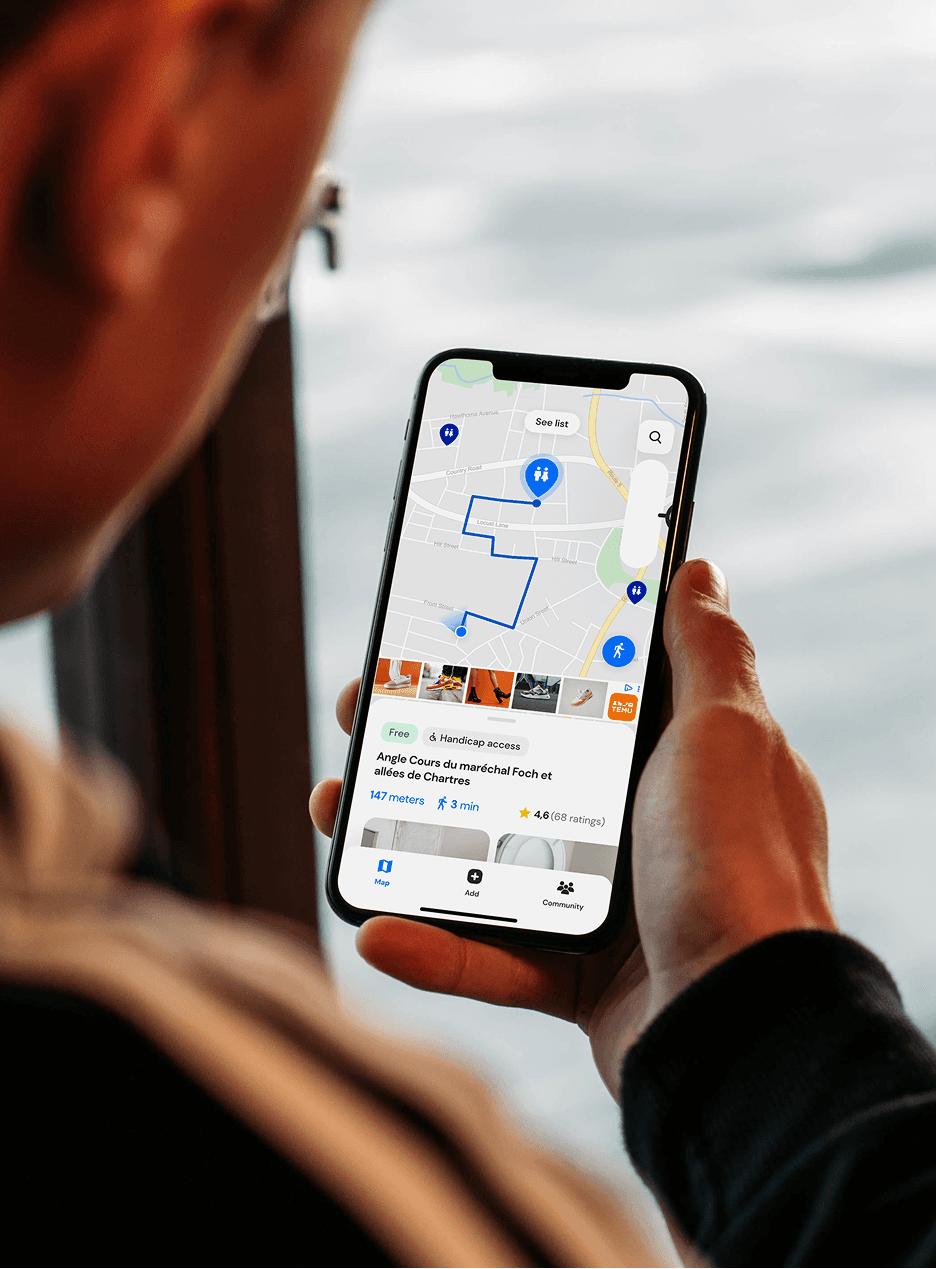
2008: The App Store had just opened, and geolocation was only just making its debut on the iPhone. A very simple question then crossed our teams’ minds: what if we used it to meet a need that everyone is familiar with, but which nobody really talks about? Finding a public toilet, right here, right now, in a city you don’t know. In 2009, this idea became Toilet Finder.
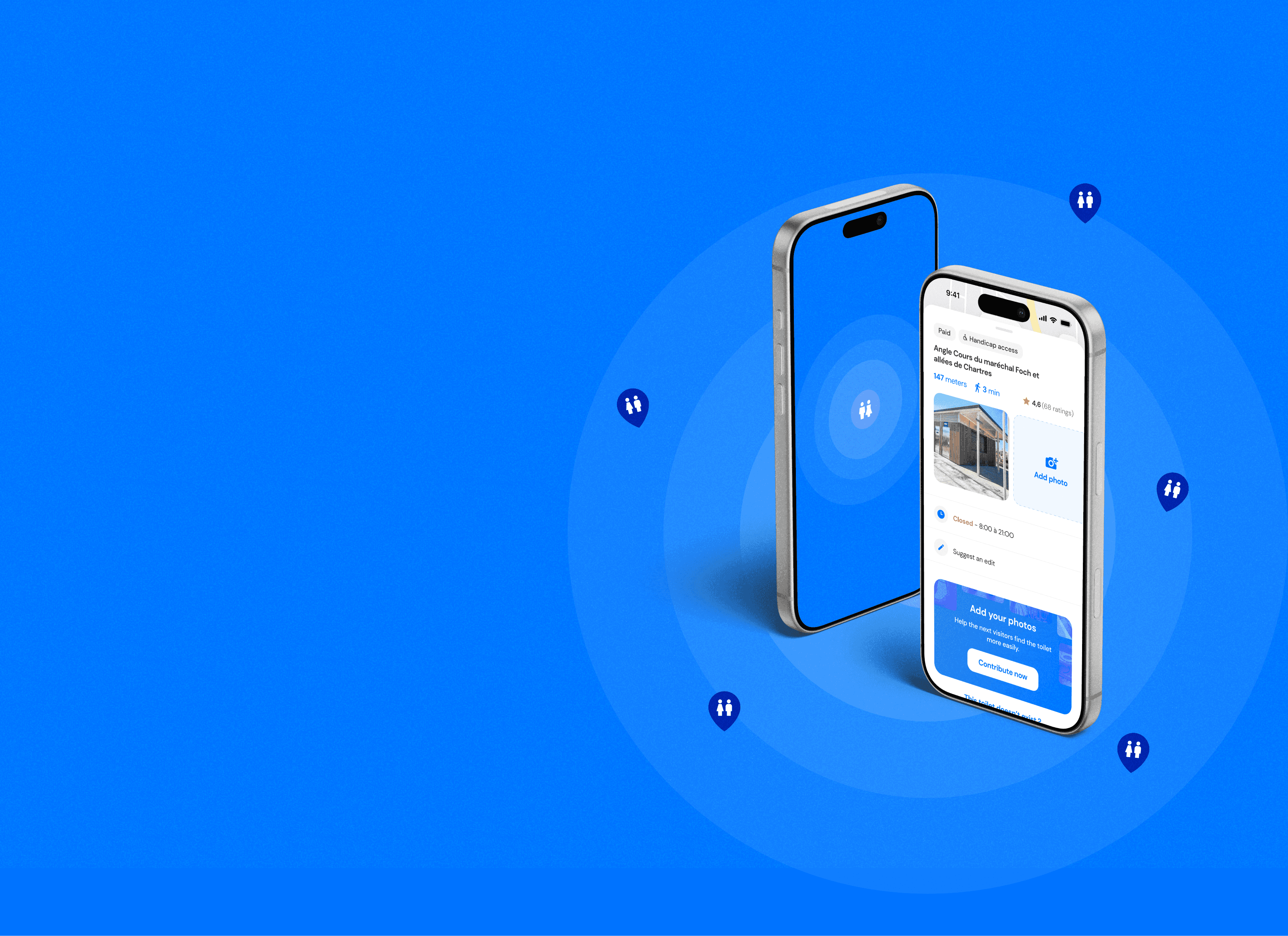
The initial idea is based on the databases provided by the local authorities. But very quickly, our teams opened up the app to its users themselves: anyone can now add or provide details about a toilet, with a simple rule to ensure the reliability of the data, any change must be confirmed by at least two different users. This shift changed everything: the database is growing faster than any city could have achieved on its own, and now covers more than 150 countries.
The technical architecture has kept pace with these developments. The app, originally developed in Ionic, has been running on React Native since 2020. The back-end, originally written in PHP, was rebuilt using Spring Boot in 2021, with a moderation back-office built in Angular. In 2023, a community photo feature was introduced to put users’ minds at ease even before they set off; moderation has been supported by Gemini since September 2025.
This reliability has also won over Apple, which uses our database to power Maps. Partnerships with the Goodlife laboratory in Belgium and the AFA Crohn RCH France charity have enriched the database, particularly with regard to toilets accessible to holders of the Carte Urgence Toilettes, a card designed for people with chronic inflammatory bowel diseases, for whom finding a toilet quickly is not a matter of convenience but a necessity.
Twelve years after its launch, the app lists 534,000 locations in 150 countries and is available in 9 languages. Rated 4.6 out of 5 by its users, the app was highlighted to mark World Toilet Day 2025, alongside the UN and UNICEF.
Verified toilets
A database that is constantly growing thanks to the community since 2009.
countries
Toilet Finder is now available in 150 countries around the world.
languages
English, French, German, Spanish, Italian, Japanese, Dutch, Hindi and Bengali

CHALLENGES
Tech
Keeping an app running for over a decade means rewriting what needs to be rewritten, without ever interrupting the service. We’ve developed Toilet Finder in stages: the switch from Ionic to React Native in 2020, followed by the rebuild of the back-end from PHP to Spring Boot in 2021, with a new moderation back-office built in Angular.
The other challenge concerns the data itself. Toilet Finder feeds Apple Maps with a curated export of its toilet database, which requires the information provided to be highly reliable. A dedicated data stack also makes it possible to track the geographical origin of searches, in order to prioritise the areas where data needs to be enriched. Moderation of user-submitted photos is based on two layers: AWS Rekognition, in place since the feature’s launch, automatically filters out inappropriate content; supplementary moderation by Gemini, added in November 2025, analyses the remaining content and replaces the human moderation step that previously followed. The aim is to operate as close to real time as possible, with feedback provided to the user within around fifteen seconds, whether to confirm that their photo has been approved or to explain why it has been rejected. The sheer volume of reviews posted by the community presented another challenge: analyzing them without devoting excessive resources to the task. For Toilet Finder, we developed a solution based on algorithmic clustering and generative AI that automatically groups reviews by topic and extracts actionable summaries from them, enabling us to more quickly identify trends that can help improve the product.
Design
An app used in 150 countries by a wide variety of users (travellers, local residents, people with disabilities or chronic illnesses) requires an interface that remains easy to use even in a hurry. The most frequently used feature must remain the easiest to access: finding the nearest toilet with as few steps as possible.
The addition of the photo feature in 2023 required us to rethink the contribution process without complicating the main search experience. We also designed the integration of partner toilets into the AFA Crohn RCH France Emergency Toilet Map. The app has also been adapted for event-specific visual identities, such as for World Toilet Day or in partnership with Goodlife, without ever complicating the main search experience.
Marketing
Toilet Finder owes its growth to its partnerships rather than a traditional acquisition strategy. The most significant partnership is with Apple, which uses our database to power Maps and gives the app global exposure without a dedicated marketing budget.
To mark World Toilet Day on November 19, 2025 (a joint initiative of the UN and UNICEF), we partnered with AFA Crohn RCH France to create a dedicated campaign within the app itself: educational content on access to sanitation around the world (3.4 billion people still live without safe sanitation services). This campaign also led to Toilet Finder’s nomination for the World Toilet Day Awards.
TURNING AN URGENT NEED INTO A SIMPLE REFLEX
Toilet Finder reminds us that a useful app isn’t useful because it solves a complex problem, but because it solves a real problem that everyone faces every day, often as a matter of urgency. Its longevity stems from our ability to develop its architecture in stages, without ever undermining the trust we’ve built with its community.
Our Client
BeTomorrow, a digital services agency founded in Bordeaux, specialises in technology, data, artificial intelligence, product design and innovation strategy, and holds the Research and Innovation Tax Credit accreditation and the AI Ambassador label.
Toilet Finder is not a client project but an app designed, developed and maintained in-house by our own teams since 2014, conceived as a concrete demonstration that our design and development standards can have a real and lasting impact on the daily lives of millions of people around the world. Twelve years on, this project continues to be driven by the same teams that have nurtured its growth.

FREQUENTLY ASKED QUESTIONS – THE RIGHT PLACE, AT THE RIGHT TIME, EVERY TIME
What happens if two users disagree about whether there is a toilet?
Adding or editing a toilet is instantaneous; it only takes a single submission. Deleting a location, however, requires double confirmation: two different users, other than the person who created the listing, must request it. To appear on Apple Maps, a toilet must also be public and approved by a community manager.
How can you tell if a toilet is accessible to people with reduced mobility?
Each location listed on Toilet Finder can be supplemented with additional information by the community, including details on accessibility. The partner toilets featured on the AFA Crohn RCH France Emergency Toilet Map, designed for people with chronic inflammatory bowel diseases, are specifically identified for cardholders.
Could Toilet Finder have been replaced by a simple data layer in Apple Maps?
Answer: No. To appear on Apple Maps, a toilet must be public and verified. Apple therefore uses a curated selection from the database, but does not replicate the mechanisms that keep it updated on a day-to-day basis: an active community that freely adds and edits entries, and stricter controls on deletions. AI moderation, meanwhile, currently applies only to photos added by users, not to the toilet listings themselves.
Has the partnership with AFA Crohn RCH France changed the way the app is designed?
Yes, indirectly. An app originally designed to meet a one-off, universal need (finding toilets whilst travelling) must also address a constant and vital need for certain users, those suffering from chronic inflammatory bowel diseases. Including partner venues on the Carte Urgence Toilettes meant we had to devise a hierarchy of urgency for the display of results something the app did not need to manage when it was first launched.
Can Toilet Finder really help a local authority to improve the placement of its public toilets?
Yes: beyond individual use, the data stack built to track users’ searches makes it possible to identify areas where demand exceeds existing supply. This data, originally intended for the app itself, can serve as a basis for planning decisions, a use that goes beyond the app’s primary function.