From the goat farm to the statutory declaration
EXPERTISES
Everything moves quickly in a goat barn. Goats are constantly moving, climbing and looking for food, making it impossible to enter data as you would in an office when both hands are occupied. Yet this is precisely where farmers need to record information during milking or kidding: moving a group, registering a birth or recording a health treatment.
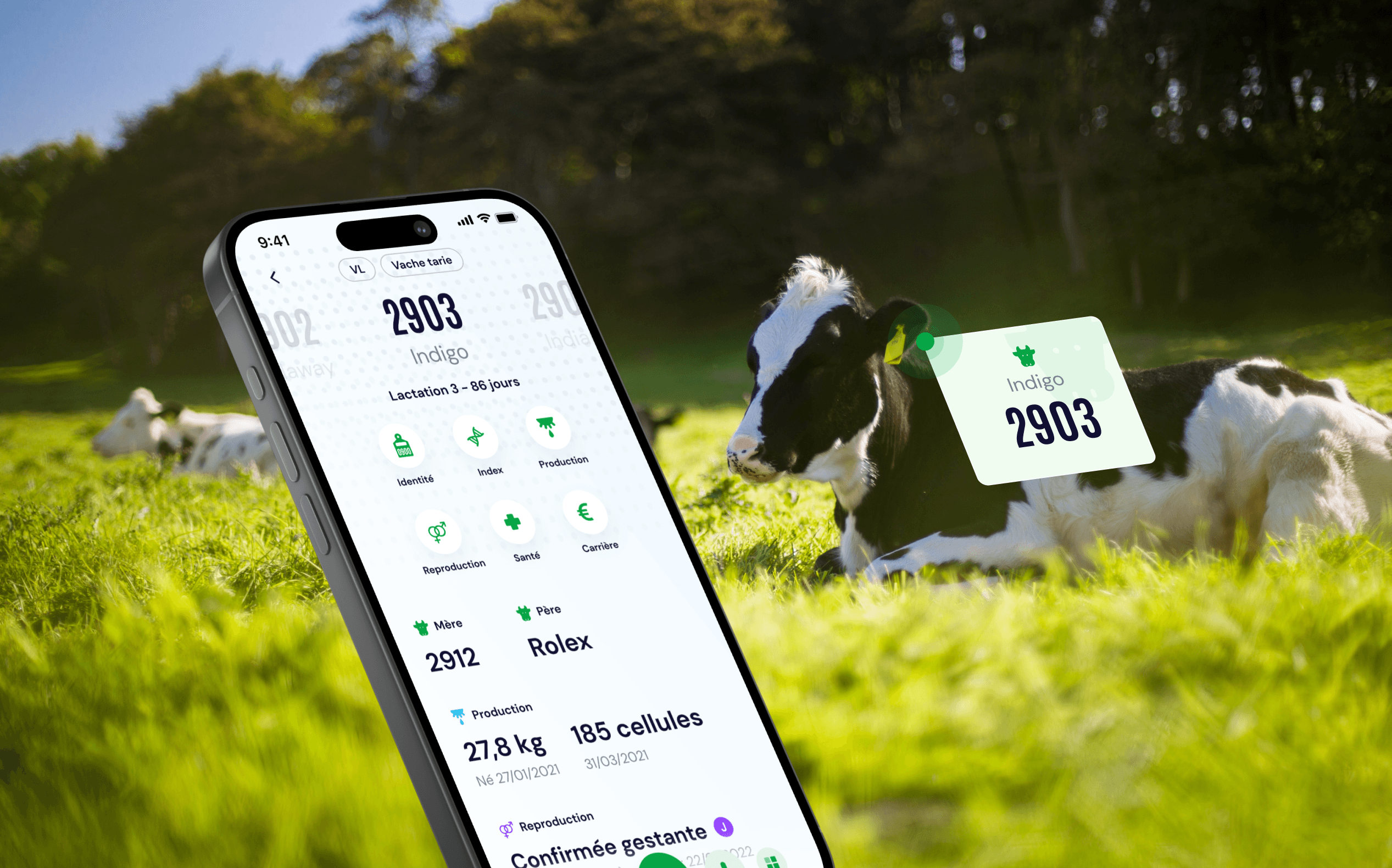
Seenovia, a livestock advisory organisation operating in France’s Pays de la Loire and Charente-Maritime regions, asked us to design UBIQ, a goat herd monitoring application intended to replace Caplait, the sector’s ageing tool. The project built on our previous work on cattle herd monitoring with Pilot’Élevage, but goat farming required us to return to the field. We visited farms to understand the diversity of their operating models and design an application genuinely suited to real-world use: group-based animal management, an experience adapted to peak kidding periods and an electronic health log, all accessible in just a few taps—even without a network connection.
Individual goat monitoring can also use readers that identify RFID tags fitted to the ear or pastern. While professional readers on the market cost between €600 and €1,000, we designed UBIQ to work with a universal reader costing less than €50—the same type used to identify any microchipped animal. This RFID compatibility makes the solution accessible to more farms without compromising identification reliability.
Another distinctive feature of the project is the electronic submission of regulatory declarations, such as births and herd movements, directly to the livestock registration authorities. The flow had to comply with a strict format imposed by the French government. The stakes were high: farmers have only a few days to report an event, and any interruption directly penalises them. We developed and secured the application using Java/Kotlin with Spring Boot, hosted on Azure Container Apps, with a Terraform, Docker and GitLab CI pipeline to make every production release more reliable.
UBIQ is a single cross-platform application for iOS, Android and the web, built with React Native for use in goat barns—with hands kept free as much as possible—as well as on desktop computers in the office. It also works offline: entries remain stored on the phone and synchronise as soon as the connection returns.
Developed in just a few months through iterative releases tested directly in the field, UBIQ is now used by goat farmers supported by Seenovia and Eilyps. Adoption has expanded beyond members enrolled in performance-monitoring programmes.
goats tracked in the application
Number of animals whose data is currently managed through UBIQ.
health events reported
Monthly volume of reports recorded directly in the field.
monthly active users
Farmers and staff using the mobile application every day.


CHALLENGES
Tech
The project’s main technical challenge was not the application itself, but its ability to communicate reliably with government systems. Unlike cattle monitoring, where declarations were handled by a third party, we had to build the regulatory reporting flow to the livestock registration authorities (EDEs) ourselves. This involved depositing XML files on FTP servers using a file format strictly defined by the French government. The flow had to be reliable from day one: farmers have six days to report an event, such as a birth or an animal leaving the herd, and any interruption can cause them to miss the legal deadline, with direct consequences.
The second technical challenge involved RFID integration. We chose a universal RFID reader costing less than €50 instead of professional devices designed for goat farming, which often cost more than €600. This decision required us to adapt the mobile and web applications so that the software could provide the functionality normally built into a professional reader, without compromising scan reliability or data-entry speed in the field.
Agility
The goat-farming project could not simply replicate the work already completed for cattle monitoring with Pilot’Élevage. We visited farms to observe the daily reality of a goat barn: managing groups rather than individual animals, redirecting goats after milking based on their RFID identification, and entering data hands-free in a noisy, constantly changing environment. These field visits directly informed our product decisions, particularly the specific handling of animal groups and data-entry workflows in the milking parlour.
We worked in short cycles, gathering regular feedback from Seenovia’s teams and pilot farmers to adapt the application to real-world use rather than assumptions. This close connection to the field also helped us anticipate practical pain points, such as the need to keep both hands free during milking, and shape the mobile experience accordingly.
UNDERSTAND THE FIELD BEFORE WRITING THE FIRST LINE OF CODE
UBIQ reminded us that livestock management software cannot be designed from behind a desk. A goat barn imposes its own constraints: noise, constant movement, occupied hands and sometimes no network coverage. We could not have anticipated choices such as group management or the ergonomics of data entry in the milking parlour without observing farmers at work firsthand.
The project also confirmed that a regulatory integration, however technical and invisible it may be to the end user, deserves the same level of rigour as the visible part of an application. Farmers never see the XML/FTP flow to the livestock registration authorities in the interface, but its reliability directly determines whether they can meet their legal obligations. Building this component required heightened vigilance during the first production deployments instead of relying solely on the provided specification.
Finally, choosing a universal RFID reader costing less than €50 instead of expensive proprietary hardware illustrates a conviction we see across other projects: the best technical solution is not always the most sophisticated one, but the one that makes a tool genuinely accessible to the people who use it every day.
Our Client
Seenovia is a livestock advisory organisation based in France’s Pays de la Loire and Charente-Maritime regions, working alongside Eilyps in Deux-Sèvres and Ille-et-Vilaine. These organisations support cattle, sheep and goat farmers with the technical and financial management of their farms, including performance monitoring, animal health monitoring and livestock advice. UBIQ is intended to expand to other goat-farming advisory organisations across France, replacing Caplait, the sector’s former information system.

FREQUENTLY ASKED QUESTIONS — UBIQ
Our organisation still uses an ageing tool such as Caplait. How long does it take to replace it with an application like UBIQ?
The timeline depends primarily on the complexity of the regulatory integrations with government systems and the migration of livestock data, rather than on the application itself. For UBIQ, the most time-consuming part was making the reporting flow to the livestock registration authorities and the data exchanges with the national database fully reliable.
Our teams do not have time to write detailed specifications for their field workflows. Is that a barrier to starting a project with you?
No—this is actually our usual starting point. For UBIQ, we went directly into goat barns to observe farmers at work instead of waiting for an exhaustive specification document. This field immersion, with farmers who became beta testers, allowed us to build the application around real workflows rather than assumptions.
Is an integration with a government authority or third-party organisation—such as for reporting or regulatory compliance—riskier than conventional application development?
Yes, and the risk is often underestimated. With UBIQ, an interruption in the regulatory reporting flow can cause a farmer to miss the six-day legal deadline, with direct consequences. We apply the same level of rigour to this type of component as we do to the visible part of the application, with heightened monitoring during the first deployments when no test environment is available.
Can an existing application be reused for a related sector—for example, adapted from cattle to goats—instead of starting from scratch?
Partly. The technical architecture and some of the experience gained can be reused, as we did between Pilot’Élevage and UBIQ. But business workflows do not transfer automatically: a goat barn is not a cattle shed, and the interface and group-management choices had to be rethought based on field observations specific to goat farming.
How do you choose between dedicated professional hardware and consumer equipment for field users without compromising reliability?
For UBIQ, we chose a universal RFID reader costing less than €50 instead of proprietary hardware costing more than €600. This required us to adapt the software to ensure the same scanning reliability. Decisions of this kind are made case by case, based on the number of users to equip and the level of robustness genuinely required in the field.